
* All product/brand names, logos, and trademarks are property of their respective owners.
For years, a degree was seen as the safest ticket to a good job. It showed that someone had studied a subject, completed assignments, passed exams, and earned formal recognition. That still matters in many fields. But today, employers are also asking a different question: Can this person actually do the work?
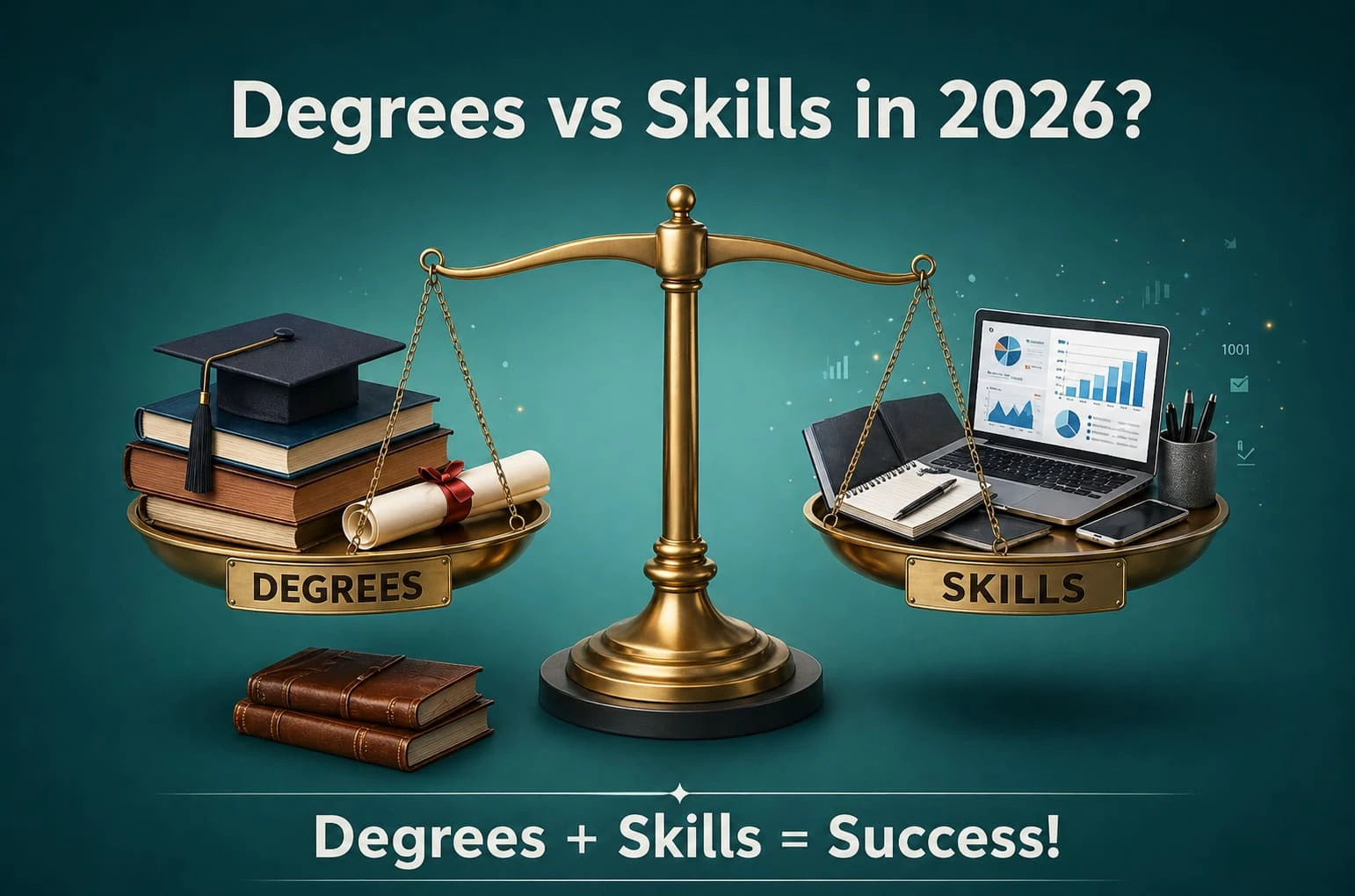
So, the real answer is not as simple as “skills matter more” or “degrees are still everything.” Today’s job market rewards people who can prove their value. Sometimes that proof comes through a degree. Sometimes it comes through hands-on skills, real projects, certifications, internships, or work experience.
The smartest approach is understanding where each one matters and how to build a career profile that employers actually trust.
Many companies now care more about whether a person can handle real tasks. For example, a marketing candidate may be asked to show campaign results. A developer may be asked to share GitHub projects. A designer may be judged by a portfolio instead of only a qualification.
This shift is happening because work itself has changed. Remote jobs, freelancing platforms, startups, and digital businesses have made talent more visible. Employers can now compare candidates from different cities and even different countries. In that environment, practical ability becomes very important.
Today, companies want people who can:
That does not mean degrees have lost all value. It means the definition of a “qualified candidate” has become wider. A degree may open the door, but skills often decide how far someone goes after entering.
Skills and degrees are often placed against each other, but they are not the same type of qualification. A degree shows formal education. Skills show practical ability. Both can help, but they prove different things.
A degree usually tells an employer that a person has studied a subject in a structured way. It can show discipline, academic knowledge, and commitment over several years. For fresh graduates, it can also provide a starting point when they do not have much work experience yet.
Here’s a clear comparison to understand how skills and degrees differ in practical terms:
| Factor | Skills | Degrees |
|---|---|---|
| Learning Approach | Hands-on, practical | Structured, theory-based |
| Time Commitment | Flexible, self-paced | Fixed (3–5 years) |
| Cost | Low to moderate | Often expensive |
| Validation | Portfolio, projects, results | Certificate or diploma |
| Industry Relevance | High in fast-changing fields | Strong in traditional professions |
There are entire sectors today where skills carry more weight than degrees. In these fields, employers care less about where you studied and more about what you can actually deliver.
This is especially true in fast-moving industries where tools, trends, and technologies keep changing. A degree earned a few years ago may not reflect current knowledge, but updated skills do.
In these areas, employers often look for:
Even with the rise of skills-based hiring, there are still many careers where a degree is not optional—it’s essential. These fields rely on deep theoretical knowledge, formal training, and often legal certification.
In such professions, a degree is more than just a qualification. It acts as proof that a person has met strict academic and professional standards.
Hiring today is less about ticking boxes and more about proving value. Employers are no longer impressed by qualifications alone—they want to see how a candidate thinks, works, and contributes.
A polished resume might get attention, but it’s not enough to secure a role anymore. What really stands out is a combination of ability, attitude, and real-world evidence.
One major shift is how candidates present themselves.
In many roles today, especially in tech, marketing, and creative fields, a portfolio carries more weight. It answers the employer’s main question instantly: Can this person do the job?
For example:
Most employers are not choosing between skills or degrees. They are looking at a mix:
Skills + Experience + Attitude = Hireability
A degree can support this, but it rarely replaces these core factors.
This is why many candidates with average academic backgrounds still land great jobs they focus on building real, usable skills and can clearly demonstrate their value.
At the same time, candidates with strong degrees but no practical exposure may struggle to stand out.
The message is clear: employers want proof, not just promises.
Traditional degrees are no longer the only path to building a strong career. Over the past few years, several alternatives have gained serious credibility, especially in industries that value practical skills.
For example, someone can complete a Google Data Analytics certificate in a few months and start applying for entry-level roles. Similarly, many developers today are self-taught, building real projects instead of spending years in formal education..
The most effective approach in today’s job market is not choosing one side—it’s combining both. People who understand theory and can apply it in real situations tend to stand out quickly.
A degree can give you structure, foundational knowledge, and credibility. Skills turn that knowledge into something useful. When both come together, it creates a strong, well-rounded profile.
Think of it this way:
When these three align, your chances of getting hired—and growing in your careerimprove significantly.
Instead of relying only on formal education or only on skills, a smarter strategy is to:
This approach reduces risk. If one area is weak, the other supports it.
Many candidates fall into one of these categories:
Those who combine both avoid this gap.
They can:
That’s exactly the type of candidate most employers prefer today.
No matter where you are in your career, there are practical ways to stay competitive. The goal is simple: become someone who can both learn and deliver.
Instead of asking “skills or degree?”, ask:
“Can I prove that I can do the job?”
That mindset changes how you learn, build your profile, and approach opportunities.
The debate around skills vs degrees often sounds like a choice between two sides, but the reality is more balanced. Both still matter—just in different ways.
Degrees continue to hold strong value in structured and regulated professions. They also help open doors, especially early in a career. But skills are what drive performance, growth, and long-term success in most modern roles.
Today’s job market rewards people who can adapt, learn continuously, and show real results. A degree alone is no longer enough, and skills without direction can limit growth.
The strongest position lies in combining both building knowledge, developing practical ability, and proving your value through action.
If there’s one clear takeaway, it’s this: focus on becoming capable, not just qualified.

No bio available yet.
Be the first to share your thoughts
No comments yet. Be the first to comment!
Share your thoughts and join the discussion below.