* All product/brand names, logos, and trademarks are property of their respective owners.
When patience runs out and diplomacy fails, the guns speak.Pakistan's most consequential military operation in decades came to be and what it means for the future of the region.
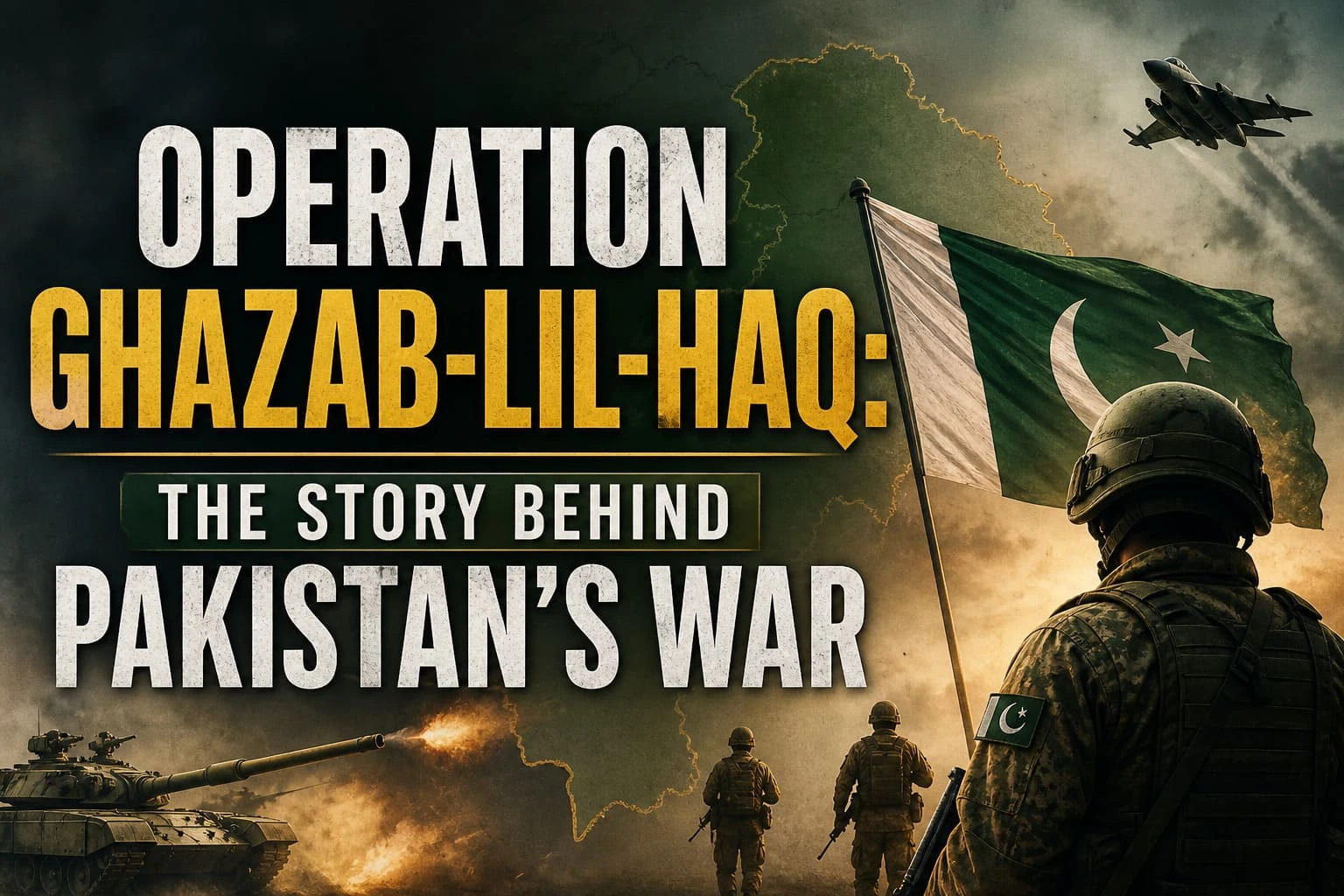
There is a moment in every long and bitter conflict when a country decides it has had enough. For Pakistan, that moment came at dawn on 26 February 2026, when the Pakistan Army and the Pakistan Air Force launched one of the most sweeping cross-border military operations in the country's history. They gave it a name that left nothing to the imagination: Ghazab-lil-Haq — "Wrath for the Truth."
This was not a snap decision. It was the result of years of failed diplomacy, bleeding borders, and a neighbour that Pakistan felt had repaid friendship with betrayal. To truly understand why this operation happened, you have to go back much further than February 2026.
"Pakistan's patience has exhausted vis-à-vis Afghanistan."
Khawaja Asif, Pakistani Defence Minister, February 2026
The story of Pakistan and Afghanistan is, at its heart, the story of a line — the Durand Line. Drawn in 1893 by British colonial administrators, this 2,640-kilometre boundary split Pashtun tribal lands right down the middle, separating families, clans, and communities between two countries that did not yet exist as modern states.
Pakistan inherited this line at independence in 1947 and recognises it as its official international border. Afghanistan never has. Every Afghan government — from monarchs to communists to the Taliban — has rejected the Durand Line, arguing it was imposed by colonial force and illegally divides the Pashtun and Baloch homelands. That single disagreement has poisoned the relationship between the two countries for nearly eight decades.
When the Afghan Taliban returned to power in August 2021 after the United States withdrawal, Pakistan quietly hoped things might be different this time. Islamabad had maintained connections with the Taliban for years and believed a Taliban-run Kabul might mean a cooperative neighbour. That hope lasted barely a year.
The central problem was the Tehreek-e-Taliban Pakistan (TTP) the Pakistani Taliban, a group officially separate from the Afghan Taliban but deeply connected to them by ideology, ethnicity, and blood ties. The TTP had been conducting terrorist attacks inside Pakistan for years, killing soldiers, police officers, and ordinary civilians. Pakistan repeatedly asked the Afghan Taliban government to act against TTP sanctuaries on Afghan soil. The response from Kabul was either silence or denial.
Over 65 rounds of diplomatic engagement produced nothing. Ceasefires brokered by Qatar and Turkey collapsed as quickly as they were signed. The Torkham crossing — one of the busiest trade arteries between the two countries — was closed in October 2025 following deadly clashes, halting trade and stranding thousands of people on both sides. And through it all, attacks inside Pakistan continued. Pakistani security forces in Khyber Pakhtunkhwa recorded 240 terror-related incidents in the period before the operation launched.
Pakistan had also accused the Afghan Taliban of allowing ISIS-Khorasan Province to operate from Afghan soil. UN monitoring reports had noted that the Taliban administration created what analysts called a "permissive environment" for multiple terrorist groups, including Al-Qaeda and ISIS-K — a direct violation of counter-terrorism obligations under the 2020 and 2025 Doha Agreements.
On 21 February 2026, Pakistan conducted airstrikes inside Afghanistan targeting TTP and ISIS-K camps. It was a warning shot — a signal that Islamabad's posture was shifting. Five days later, on 26 February, Afghan Taliban forces launched retaliatory attacks on Pakistani military positions along the border, describing them as a "calculated response."
That was the breaking point. Pakistan declared open war and launched Operation Ghazab-lil-Haq the same day.

The scale and reach of the operation surprised many observers. This was not a series of symbolic strikes along the border. The Pakistan Air Force hit targets deep inside Afghanistan — striking corps headquarters, brigade and battalion command posts, ammunition depots, logistics bases, and drone storage sites in Nangarhar and Jalalabad. Ground forces captured Afghan Taliban outposts and hoisted the Pakistani flag over them, a deeply symbolic act.
Pakistani forces also seized what officials described as a strategic 32 square kilometres of Afghan territory in the Ghudwana enclave, south of the Zhob sector near Kandahar Province. This was not just a tactical move — it was a message about Pakistan's willingness to hold territory if necessary.
Pakistan lost 12 soldiers killed, 27 wounded, and one missing in action numbers that the military acknowledged publicly, a sign of the operation's seriousness. Afghanistan's government disputed Pakistani casualty figures and claimed its own version of events, as is typical in any conflict.
Perhaps the most significant aspect of Operation Ghazab-lil-Haq is not what it did but what it represents. For years, Pakistan fought terrorism on its own soil, absorbing attack after attack in a largely defensive posture. This operation changed that entirely.
As one Pakistani military analyst put it, the country had shifted from a "docile defensive mindset" to a forward-defense strategy — taking the fight across the border before the threat arrives at home. The message Pakistan sent was unambiguous: any attack launched from Afghan soil, whether by the TTP or any other group, will now carry consequences for those who harbour them on Afghan territory.
"Field Marshal Asim Munir, Pakistan's Chief of Army Staff, stated the condition for peace clearly the Afghan Taliban must renounce their support for terrorism and terrorist organisations. Until that happens, Pakistan's security posture has fundamentally changed."
The Afghan Taliban government has a very different account. Kabul has accused Pakistan of violating Afghan sovereignty, rejected the legitimacy of the Durand Line entirely, and denied providing any support to the TTP. Taliban officials described their retaliatory attacks as a calculated and justified response to Pakistani aggression.
Afghanistan also faces its own structural constraints. The ethnic and ideological ties between the Afghan Taliban and the TTP run deep — both are Pashtun movements rooted in similar religious and tribal frameworks. Asking the Afghan Taliban to actively suppress the TTP is asking them to act against their own kin, which is something no Pakistani diplomatic mission has managed to achieve, no matter how many rounds of talks were held.
"The designs of terrorists and their patrons will be reduced to dust."
— Pakistani security officials, February 2026
On 18 March 2026, Pakistan announced a temporary halt to the operation as a gesture of goodwill ahead of Eid-ul-Fitr, responding to requests from friendly Islamic nations. The Afghan Taliban's spokesperson issued a parallel announcement. For a moment, the guns fell silent.
But a ceasefire is not a peace deal. The Durand Line is still disputed. The TTP still exists and still operates from Afghan territory. The Afghan Taliban still do not formally recognise Pakistan's border. None of the root causes of this conflict have been resolved — they have simply been paused.
Pakistan's officials were explicit on this point:
The operation would resume with full force if any cross-border attack, drone incident, or terrorist activity occurred. The military's public posture made clear they were in no hurry to permanently end it — the operation would continue until the Taliban gave credible guarantees that they were actively working to suppress the TTP on Afghan soil.
This conflict does not exist in a vacuum. It has already affected trade routes, refugee movement, and regional stability across South Asia. China, which has deep economic interests in Pakistan through CPEC and maintains its own cautious engagement with the Taliban, is watching closely. The United States, which spent 20 years in Afghanistan and signed the original Doha Agreement, remains entangled in the consequences of its own withdrawal.
The Pakistan-Afghanistan conflict is also a mirror of a broader global pattern the failure of the international community to manage the Taliban's return to power and the resulting security vacuum that groups like the TTP have rushed to fill. In that sense, what Pakistan is doing is both a national security response and a symptom of a much larger problem that the world has yet to seriously confront.

Operation Ghazab-lil-Haq is not just a military operation. It is a declaration that Pakistan has changed its calculus, that it will no longer absorb terrorist attacks as simply the cost of a complicated neighbourhood, and that the era of endless, fruitless diplomacy with a government that refuses to act against those who kill Pakistani citizens is over.
Whether that declaration leads to lasting security or deeper instability, only time will tell. But one thing is certain the Pakistan-Afghanistan relationship has crossed a line it will not easily walk back from. And in the valleys and mountains along the Durand Line, the consequences of that will be felt for years to come.
The border was always a wound. Now it is a war.
The question is who will heal it, and how.

No bio available yet.
A sudden earthquake sent waves of panic across Islamabad and Rawalpindi, forcing residents to rush o
18 April 2026
Pakistan’s electricity crisis in 2026 is no longer just a headline — it’s part of
15 April 2026
Tension in the Middle East has a way of spreading far beyond the front lines. Even in places that ap
10 April 2026
Be the first to share your thoughts
No comments yet. Be the first to comment!
Share your thoughts and join the discussion below.